Background
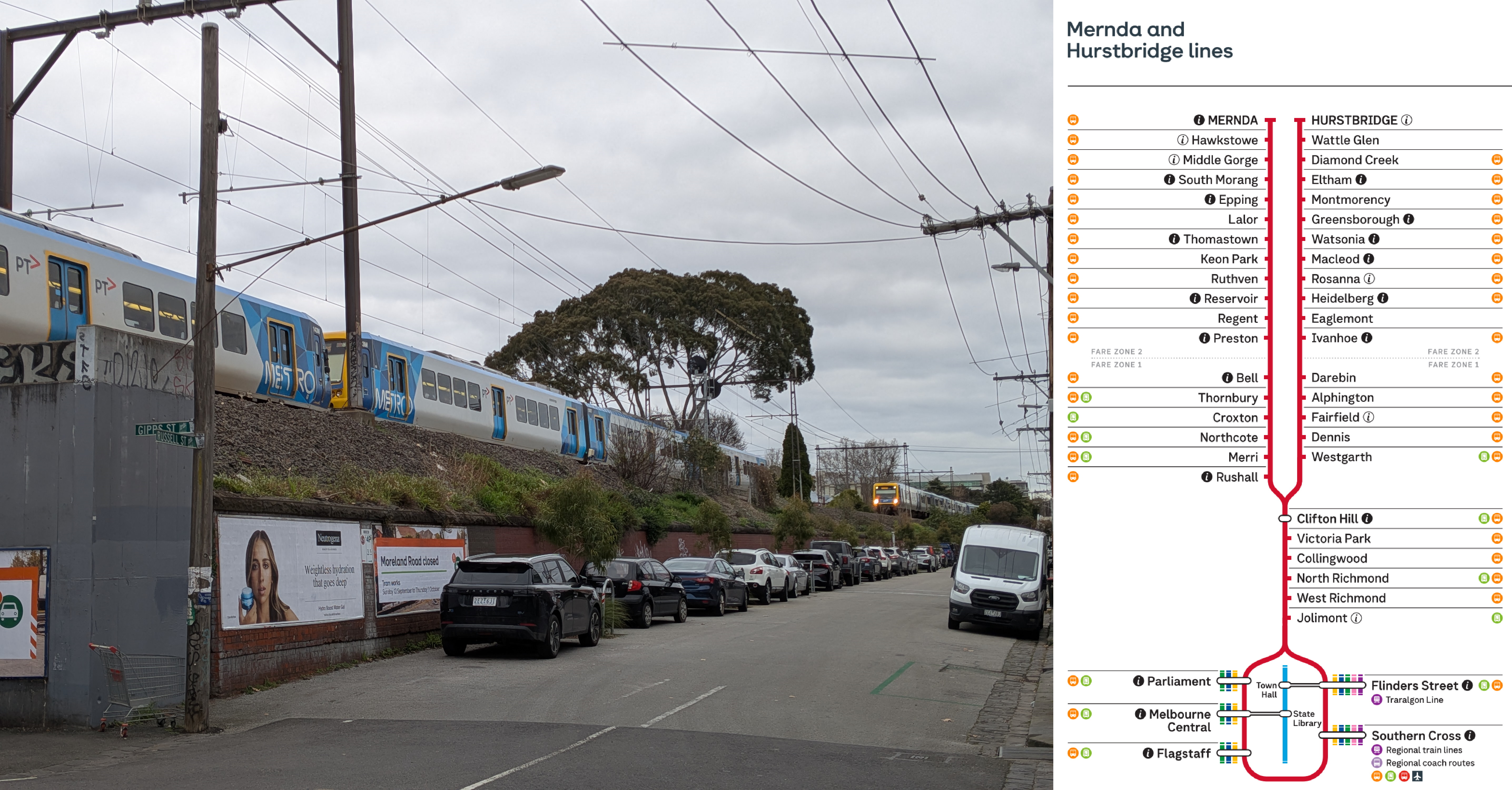
The Clifton Hill Group is made up of the Mernda and Hurstbridge Lines. The two lines share tracks from Flinders Street (normally departing platform 1), then run clockwise through Southern Cross and the City Loop,
exiting at Jolimont and continuing to Clifton Hill, where they split apart.
The Mernda Line is the busier of the two, around 9.2 million passenger per year which is on par with the Craigieburn Line, while the Hurstbridge Line with 7 million passengers is more akin to the Sandringham or Glen Waverley Lines.
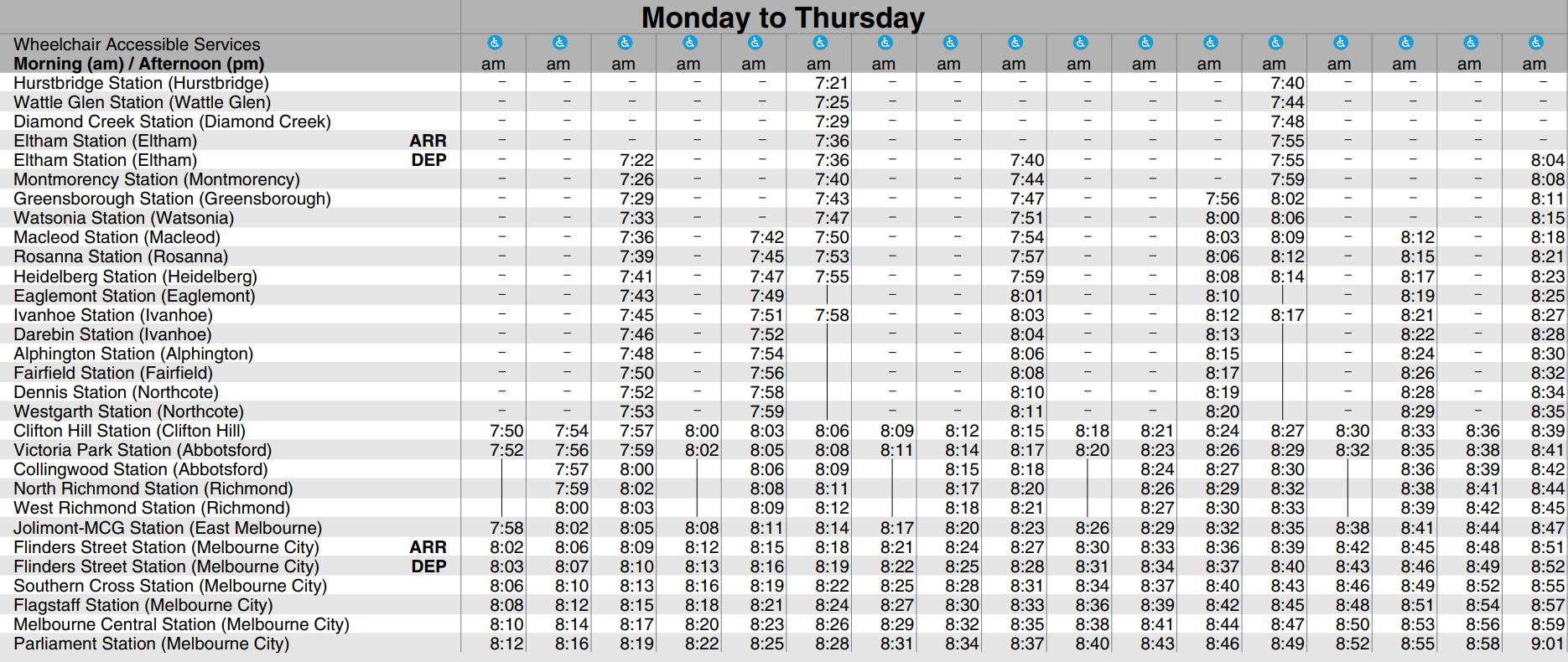
During the morning peak the group sends nearly 20 trains per hour (an average of one every 3 minutes) between Clifton Hill and the city. Outside of peak hour, and on weekends, both lines have a 20 minute frequency, with even that halving beyond Eltham towards Hurstbridge.
The shared section is double tracked from Jolimont to Clifton Hill. The Mernda Line is double tracked all the way to the end, while the Hurstbridge Line is only duplicated to Montmorency, with single track and passing loops beyond.
The flat junction at Clifton Hill
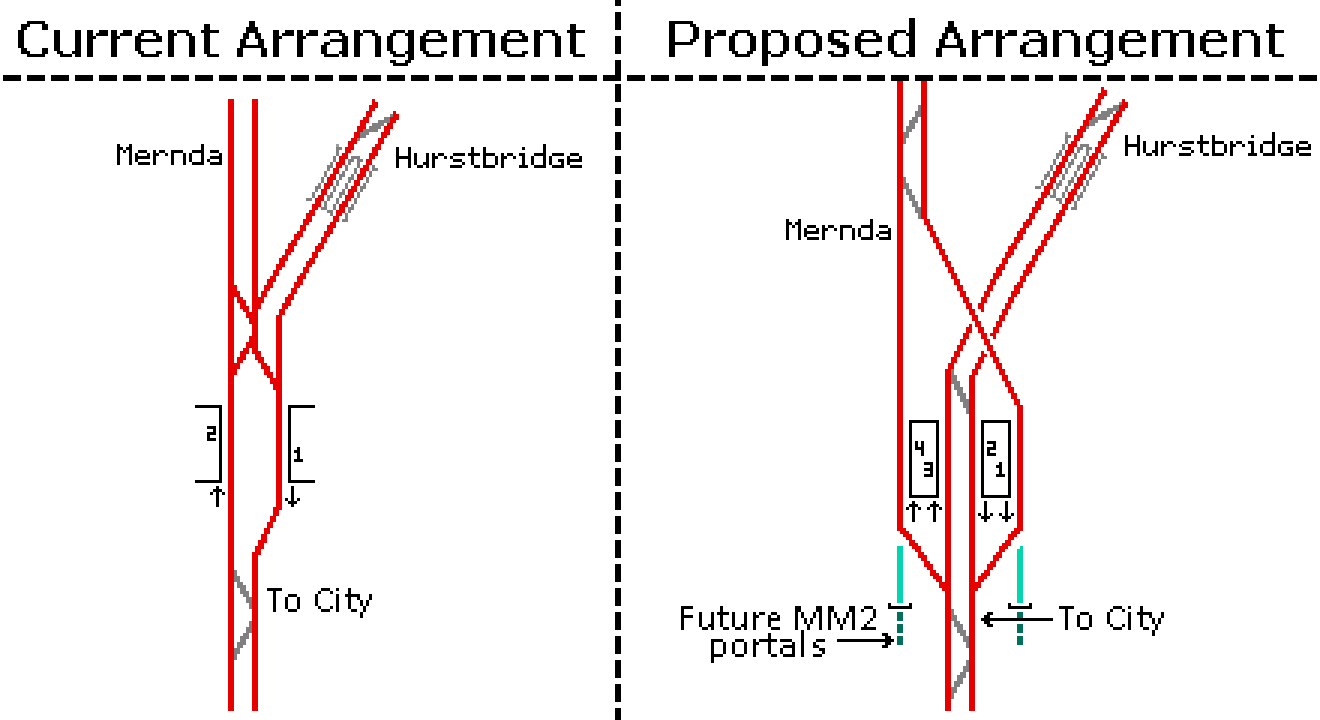
The layout of the down end of Clifton Hill means that an up Mernda train and a down Hurstbridge train cannot traverse the junction at the same time, one must wait for the other. Grade separating this junction would be key to increasing peak frequency along both lines, as well as reduce delays spreading to other services.
| Platform | Line and Direction |
|---|---|
| 1 --> | Mernda Citybound |
| 2 --> | Hurstbridge Citybound |
| 3 <-- | Hurstbridge Outbound |
| 4 <-- | Mernda Outbound |
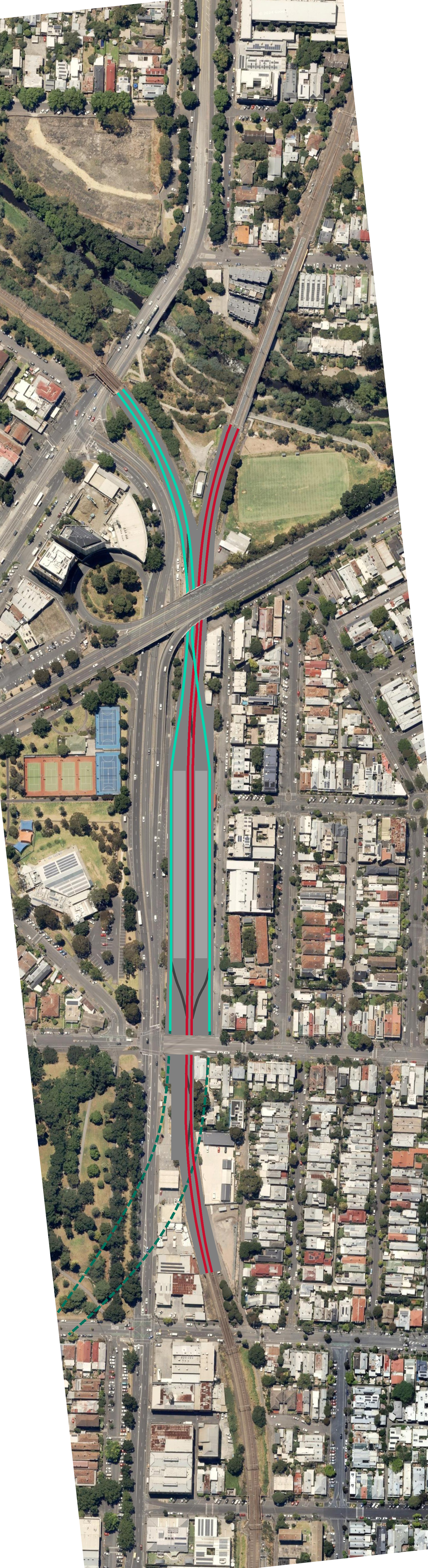
The new station would lie in a trench, to allow room under the Heidelberg Road bridge for the Mernda tracks to get over the Hurstbridge tracks. The Ramsden Street level crossing just south of the station would be removed, either with rail passing under the road, or potentially just closed entirely.
If MM2 ever gets delivered, the separated Mernda platforms in this trench could be easily fed straight into tunnels. For now, the lines would merge/separate just on the up side of the station.
What else can we do?
If we're fiddling around this much with the Clifton Hill Group, what else can we do to increase capacity, not just for now but also 5, 10, 20 years down the line? With Melbourne ever growing, new higher density around existing stations, a potential Wollert branch, barring the MM2 option how can we squeeze more trains in?
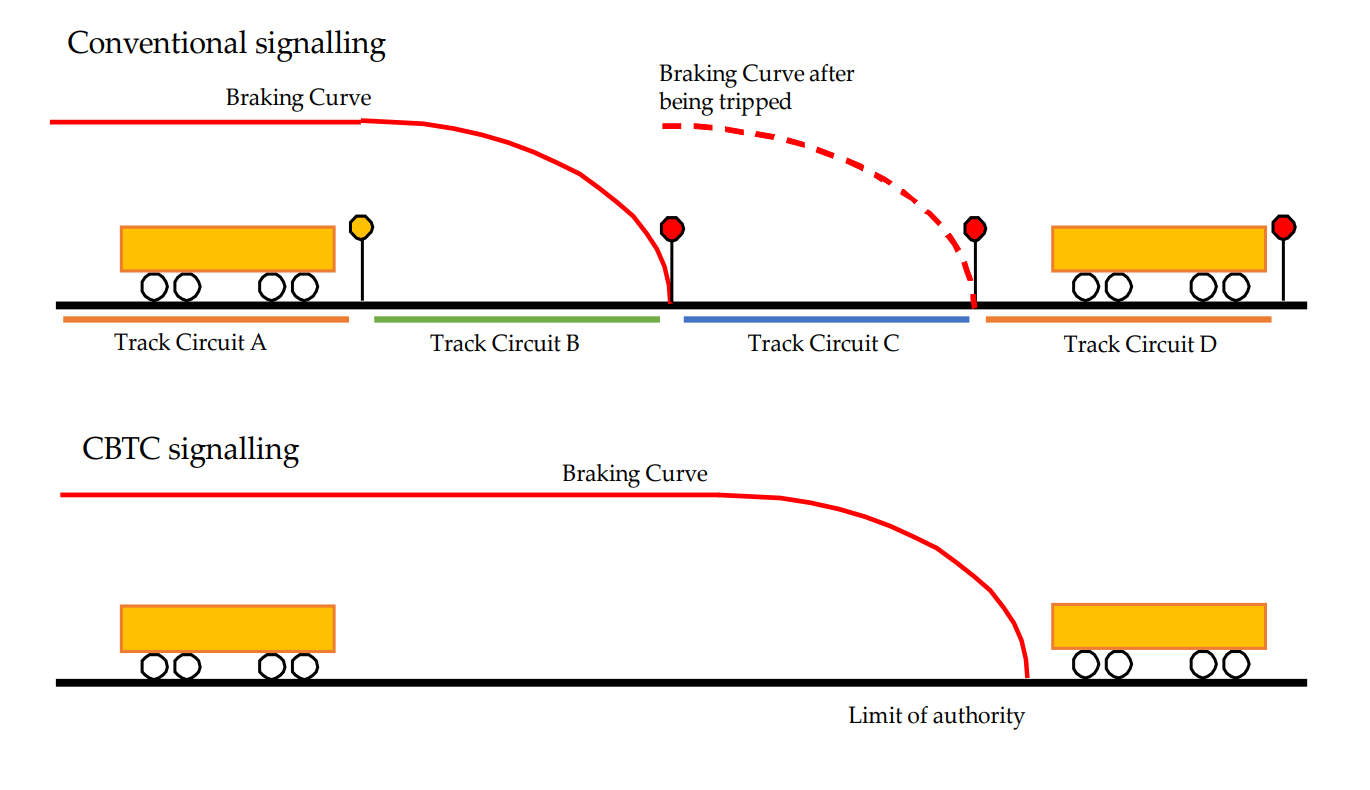
With this installation, and the previous CBTC installation from West Footscray to Clayton through the Metro Tunnel, the driver is still present in the cab, closing the doors and giving the command to start, and taking over or stopping the train if necessary.
In short, the train drives itself to the next station at a safe speed for the environment and stops in the right place. The system knows the maximum permitted speed for any given section, governed by track geometry like curves, speed restrictions over turnouts, temporary speed restrictions, and more.
The line from the City to Clifton Hill was recommended to be the second line in Melbourne to receive High Capacity Signalling in the 2012 PTV Network Development Plan (the first being the Sandringham Line to trial the technology). Of course, we have drifted away from that plan looking back 14 years later.
The current speed limit between Jolimont and Clifton Hill is 55km/h, largely due to the short distance between fixed signals, although there are a few curves in the section that would need to be traversed at around 55km/h regardless. Without being restricted by the fixed signal spacing the line speed could be increased to bring some time savings, although with the close station spacing you'd only be saving a few seconds here and there.
CBTC bring other benefits as well, with trains being able to run closer together the impact of delays would be lessened and would recover quicker. Safety is largely improved: the only protection on fixed signalling is train stops, which activates the emergency brakes on a train if it passes a signal showing stop (or in limited installations if it is travelling to fast for a section). With CBTC speed is continuously governed, and trains automatically slow if it is exceeded.
Lineside signalling would still likely be required on the line to accommodate non-CBTC equipped traffic like unusual rolling stock depot transfers, evaluation trains, works trains, not to mention the odd heritage train. The existing lineside signalling could be altered to decrease the maintenance load, and the number of signals potentially reduced. For example, S071 and its co-actor are largely tucked into the corners of the Freeman Street overpass next to West Richmond station. Signals in hard to reach places and those with co-actors can be removed or relocated in order to make it easier, and thus cheaper, to maintain.
CBTC systems are meant to be reliable and have redundancies put in, meaning the remaining fixed signals can be lifted of the burden of ever needing to provide for a high-frequency service and instead will be left just to serve the previously mentioned non-CBTC movements during off peak times.
Of course we could just remove lineside signalling altogether, but I'm not sure Melbourne's railway network is ready to take that leap.
Eventually, after the necessary level crossing removals are undertaken, CBTC could go all the way to Mernda and Montmorency (end of the double track) to increase the benefits, not only of capacity increase but lineside equipment reduction.
Related: without the need for fixed signals and all of their lineside train detection accessories it is rather easy to make tracks bidirectional. In certain situations, this can increase flexibility and allow for some form of easily implementable degraded operations in case one track is unavailable.
How much would CBTC cost?
The signalling component of the Metro Tunnel under "Rail Systems Alliance" cost about $1.58 billion (initially $1.1 billion).
They delivered around 27.2km of CBTC (all double track) between West Footscray and Clayton.
In my initial plan we need to convert around 5.4km of double track from Flinders Street to Clifton Hill, and roughly another 5.4km around the City Loop.
That's around 40% of the length of the Metro Tunnel Project installation, but it likely won't be just as easy as 40% of $1.58 billion (which is $632 million). At least it could be a vague idea of how much.
I don't know enough to comment further.
It'd be another 44.5km of installation if we went all the way to Mernda and Montmorency by the way.
Anything more for Clifton Hill to city?
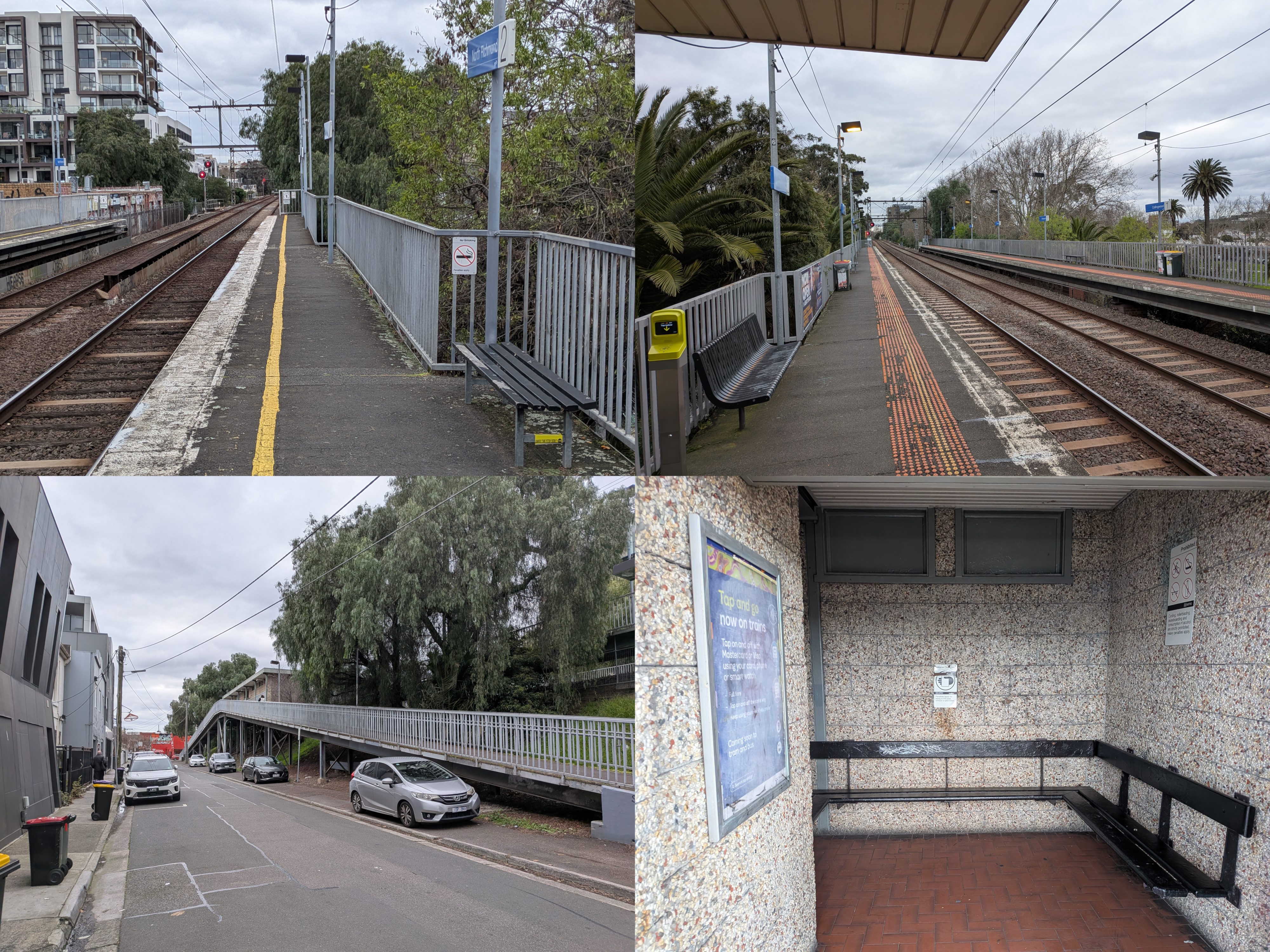
| Narrowing platform at North Richmond | Lack of shelter at Collingwood |
| Long unforgiving ramps to North Richmond | Pebbledash waiting room at Victoria Park |
Well, because you asked, let's what else we can do. Let's take a look at the stations. Victoria Park, Collingwood, and North Richmond are all cut from the same cloth.
All rebuilt in the 1980s, with distinct rigid grey painted platform fencing, limited shelter, elevated above the surrounding streets, and of course the railways classic peppercorn trees.
All three of these stations do not adhere to modern accessibility standards with regards to their ramps.
The platforms at North Richmond lack tactile dots, and the platforms can get quite narrow at parts.
Additionally, Victoria Park is famously quite egregious in the platform to train gap department.
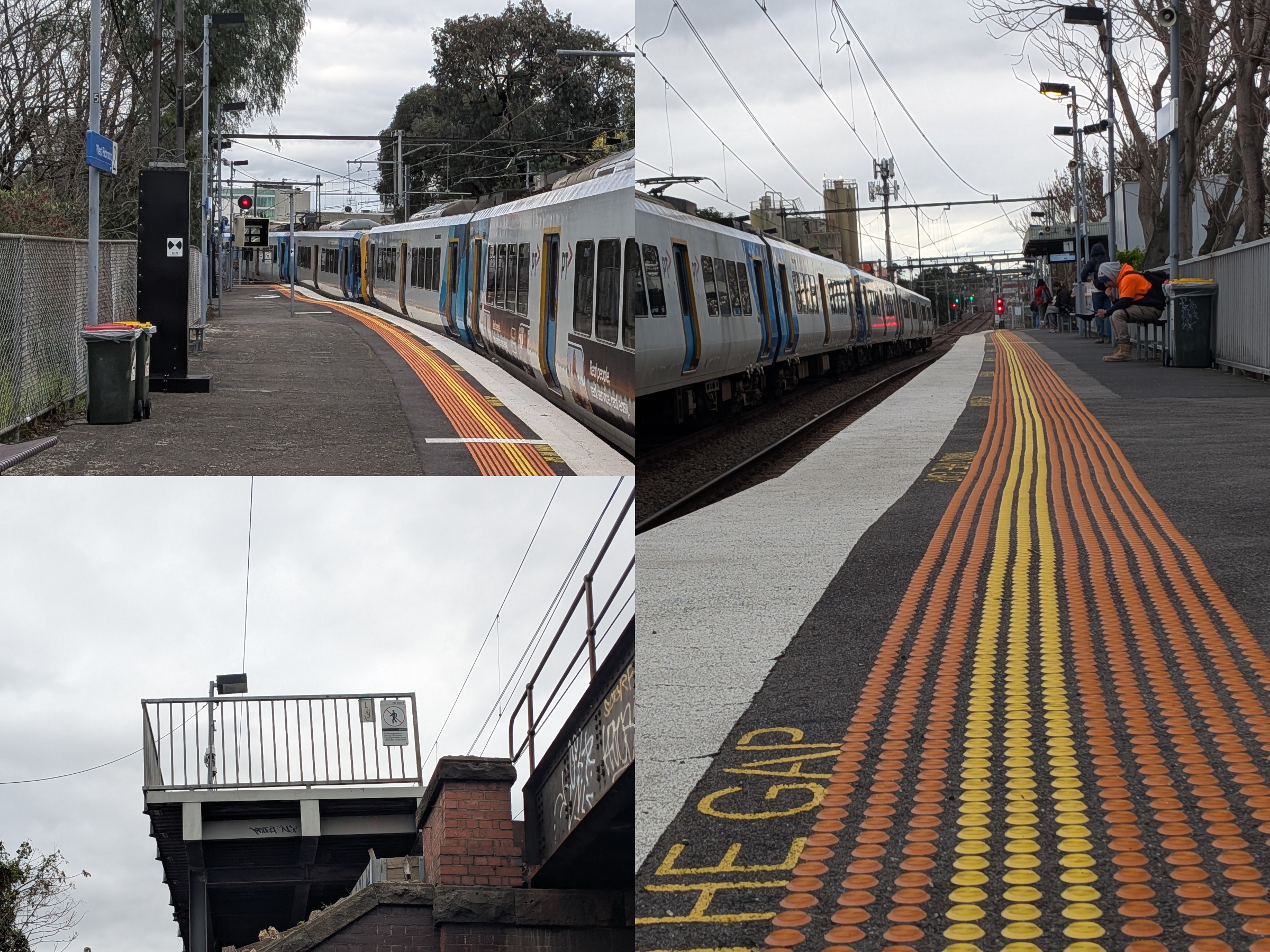
I propose a full rebuild of these stations, with all three receiving sufficiently wide, straight platforms with minimal gaps, generous shelter along the full length, full accessibility via ramps up to standard alongside stairs and a lift to each platform.
The stations would receive a near identical design to save on cost, but would have something to easily tell them apart, like a distinct colour on the walls. Some opportunities could also be available to bridge over roads like Johnston St or Victoria St and create entrances on both sides of these roads, for easier connection to trams and buses.
West Richmond is a bit better in the accessibility department, but improvements could be made to shelter and passenger information. The same could be said for Jolimont.
As for the City stations, CBTC allows for platform screen doors to be installed. I would be happy to do this at Southern Cross, Flagstaff, Melbourne Central, and Parliament. Platform screen doors improve safety by blocking access to the tracks by objects and people.
Another Potential Improvement
Two sidings current exist at Victoria Park. One is short and only used for maintenance vehicles, while the other extends over the Eastern Freeway and can store two 6-car trains, and is the closest place to city you can stable a train on the Clifton Hill Group. Another siding, on the other side of the main lines, could be built to house two more 6-car trains between peaks and overnight.What trains could we use?
It is probably best practice to design a train with CBTC in mind, like our recent HCMT and X'Trapolis 2.0 fleets.
However, it and similar systems have been retrofitted to older trains, such as the 1995 and 1996 London Tube stock.
I propose that as part of a mid-life refurbishment, the X'Trapolis 100 fleet be fitted with CBTC equipment, among other improvements like passenger information improvements, and potentially conversion to semi-permanently coupled 6-car sets with the middle driver cabs removed to provide more passenger space.
We already have experience converting X'Trap 100s to CBTC (on the Mernda Line no less).
I might do a mini blog post on that topic, but using the familiar and well ran X'Trap 100s on the Clifton Hill Group will avoid the need to buy new trains, and certify them for these lines.